

The Differences Between Water Audits and Water Audit Validations
Tim Crisp, Technical Communications Specialist
August 31, 2026
Our Engineering Services Manager Aaron M. Horbovetz, PE, PMP, sat down with Technical Communications Specialist Tim Crisp to discuss the differences between Water Audits and Water Audit Validations.
TC: For someone who isn’t familiar with water loss management, what is a Water Audit?
AH: A water audit is a systematic method for reviewing your water system and identifying where problems might be. Most people, when they hear the word “audit,” think of the IRS, or maybe a financial audit. A water audit is an accounting practice designed to quantify the volumes of water entering and leaving a water system, and to help a utility quantify losses and determine where those losses might be coming from.
TC: What kind of information is compiled into a water audit, and what does the audit tell a utility about its water system?
AH: One of the most important sources of information is the volume of water coming into the system; that could be from your utility’s own sources such as wells or reservoirs, or imported water, like when a utility purchases water from a neighboring community. Sometimes utilities have a mix, but usually it’s one or the other. That’s the first step: understanding how much water was available to distribute to your customers during the audit period.
The second major source of information is what a utility sells to its customers. There are two primary categories. The first is exporting water to a neighboring community. The second is your authorized consumption, which includes industrial, commercial, and residential billed-metered accounts, along with unbilled or unmetered distributions.
Those are the two biggest components of the water audit.
TC: So you have your water coming in and your water coming out; what other factors go into the audit process?
AH: The number of service connections, miles of main, and operating pressure, to name a few. These matter because there’s a theoretical amount of leakage that will occur based on the pressure you’re operating at and how many service connections and miles of main you have. You’ll have small leaks on service connections that will never be found. They’re difficult to detect and rarely surface. The same is true on water mains. Small leaks will go undetected. The audit spreadsheet factors in the length of the water mains, the number of service connections, and the average service connection length, and it computes a theoretical amount of loss—losses considered unrecoverable. For most systems, that theoretical loss holds pretty true, and it gives the utility an idea of how much water will never be recovered.
Once you’ve input all the values—how much water is coming into the system, how much is going out of the system—financial values are utilized to come up with estimates of how much revenue you might be losing and then determine if it’s cost-effective to try and look for that lost water. In some cases, you find that you have lost water, but it really isn’t costing you that much money, so it might not be worth paying for advanced leak detection or replacing all your meters. Or, by looking at the audit, you determine that the problem most likely isn’t in your meters; maybe it’s leaks. This allows a utility to prioritize their efforts and properly allocate capital for loss recovery.
TC: What is water audit validation then, and how is that different from simply completing a water audit?
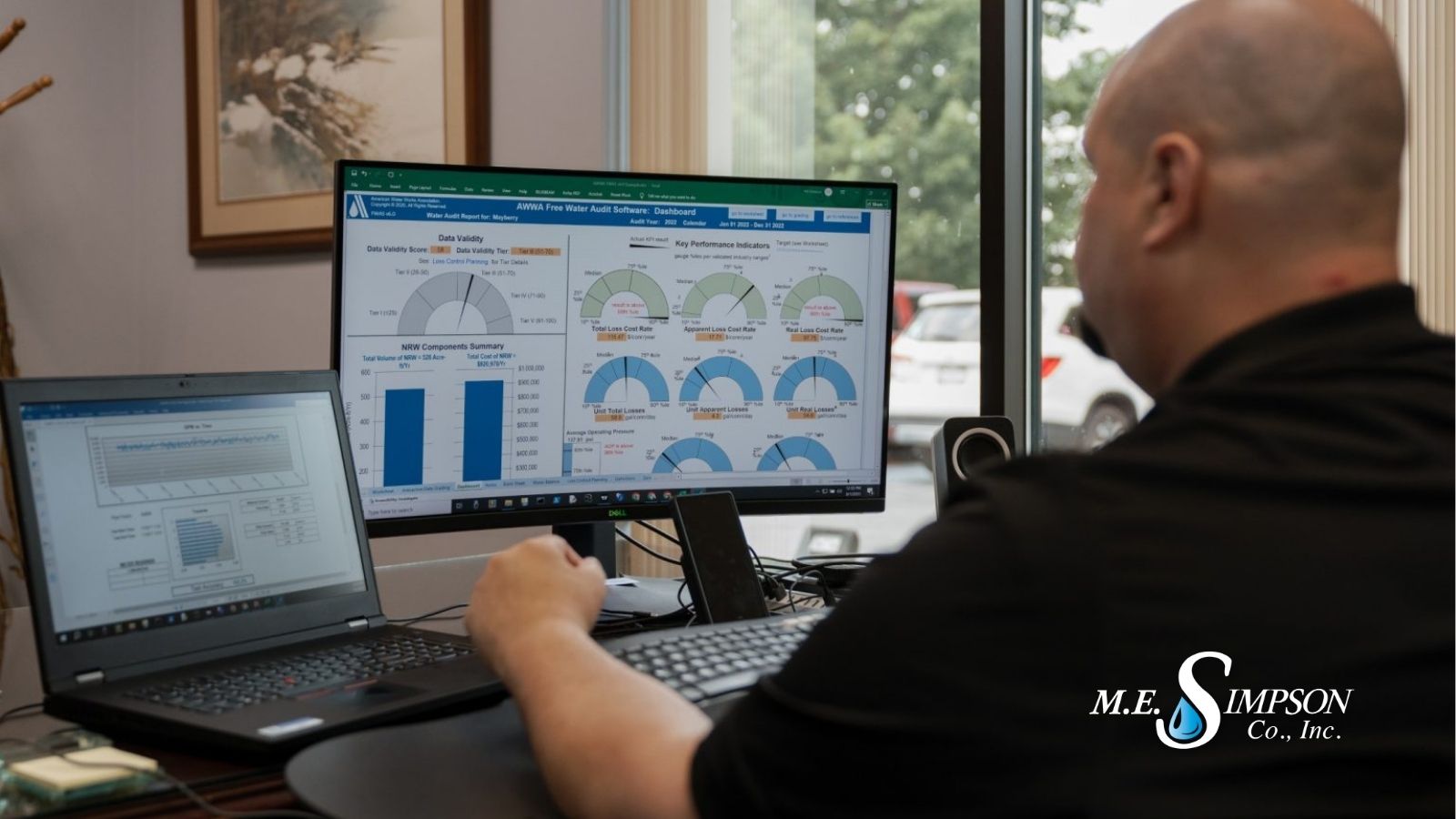
AH: So the water audit, as we discussed, is the compiling of all this information into the AWWA FWAS spreadsheet. Where that information comes from and how reliable that information is- that’s where the validation comes in.
A validator reviews the audit and its data sources to determine data quality. For example, let’s say you’re purchasing water from your neighboring community and you’ve got two meters that are tested once or twice a year, are reasonably accurate, and read daily; that gives you a pretty high confidence level in those volume numbers. Compare that to an identical situation, except the meters are never tested and are only read once a month. With unknown meter accuracy and infrequent readings, how confident can you be in that data?
The audit software allows the auditor and validator to apply grading criteria to each piece of data used in the audit. The validator looks at the data to see how well it matches the criteria, then gives it a score from 1 to 10.
TC: What are some of the most common sources of error or uncertainty in a utility’s water audit?
AH: Metering and billing are complex, and it’s not uncommon to find errors. Maintaining a large, varied meter population takes a lot of effort, so there is a high potential for errors.

TC: Can you give an example of how a utility’s initial water audit might look different after validation?
AH: As a validator, your job is not to redo the audit. It’s to note where there might be issues and then guide the auditors to get better numbers or address those pain points. Sometimes it’s not possible to obtain a better data set, and a lower validity score will reflect that. But if you can obtain better values, you’ll have a more reliable audit and a better validity score.
TC: How does validation help determine whether the audit is based on reliable data?
AH: A lot of that comes from the validity scoring. A validator has looked at the audit and determined the quality of the data, and this gives the utility a checklist for future audits because they often may not be able to correct the information for that particular audit, but now they have a roadmap for the next one. They can collect their information differently for future audits, which will raise their score.
Many utilities only conduct audits because they’re required to by law, but some do them because they want to understand their system better and have more control over it. Year over year, a utility will start to notice patterns revealed in the audits. The audit gives them ideas on how to improve their system, and over three, four, or five years their system performance continuously improves, and they use the audit as their primary tool to guide them through that process.
TC: What does the audit typically look like from the utility’s perspective?
AH: If the utility is performing the audit in-house, then from their perspective, they need to have somebody who knows what they’re doing or who has gone through the training to learn how to do it. If they’re using a third party, then they’re relying on the expertise of whoever they’ve hired. Either way, the person or small group doing the audit will request a lot of information from the utility.
Whoever conducts your audit will ask for a lot of information, and it usually takes time to gather and compile it. That’s where it starts: with a huge data request. The first time can be very daunting.
If the utility has never done an audit before, they won’t know what kind of information they need, so it can feel a little overwhelming. But future audits go much quicker because the utility’s already done them before. They’ll have a better idea of what you were looking for from their experience in the previous audit. Sometimes they’ll even start compiling the data monthly in anticipation of the next audit, so they’ll be better prepared.
TC: What are some other signs that a utility could benefit from a validated water audit?
AH: If they’re already doing an audit and the numbers just don’t seem to make sense, or there are massive losses year after year, and they’ve already checked their meters, or tested their meters, or done leak detection, or done any number of things to try and figure out where their water losses are, but something’s still wrong. Validation can help with that. A validator might come in and say, “Hey, there’s a better way to calculate this,” or “Actually, the way you’re calculating this is correct, so there’s something else going on here.” Even when the validation doesn’t give you clear-cut direction, it still raises a red flag.
TC: How often do you think a utility should do a water audit?
AH: I think utilities should conduct them annually. I think they should perform an annual audit and just make it part of their regular routine because when you do them every year, you gain experience and get accustomed to the process. That’s more of a human performance kind of thing, but when utilities do them every single year, they just get into the habit of it.
Another advantage of doing them annually is that you’ll start to notice patterns and deviations from previous audits, which can be very useful to a utility trying to optimize the performance of its system. Audits and validations truly are a fantastic tool.
Want to learn more or get started on your Water Audit project? Contact us to meet with one of our specialists.