

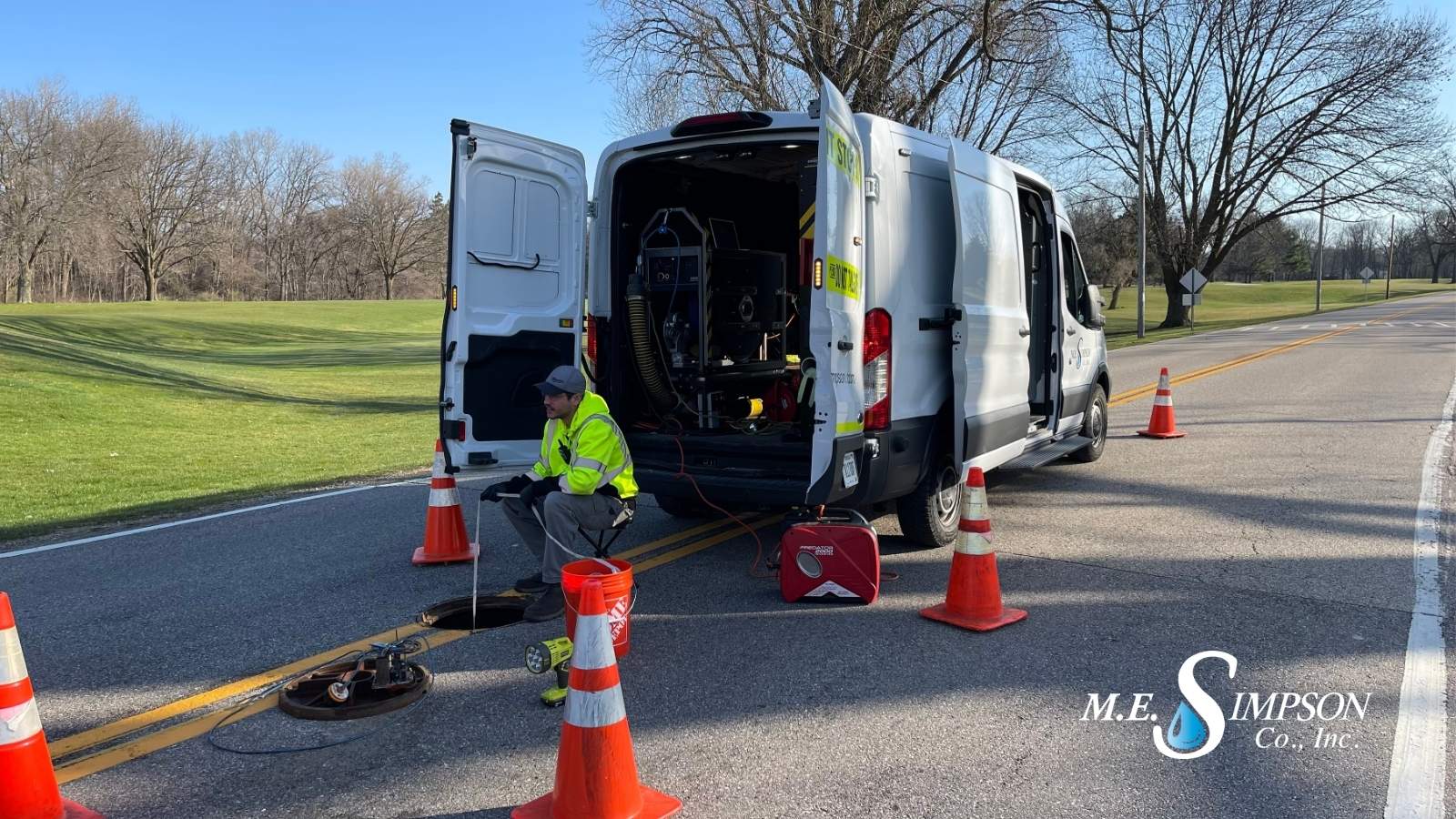
Advancing Sewer and Force Main Condition Assessment with Electro Scan
Tim Crisp, Technical Communications Specialist
September 14, 2026
Understanding the condition of a sewer collection system requires more than knowing what is visible inside a pipe. While CCTV sewer inspection has long been a valuable tool for documenting sewer defects, visual inspections alone cannot provide a complete picture of pipeline integrity. Cracks, leaks, defective joints, and other issues may be difficult or impossible to identify through a camera, leaving utilities without the information needed to make informed sewer rehabilitation and asset management decisions.
M.E. Simpson Co., Inc. provides advanced sewer condition assessment and force main condition assessment services using Electro Scan’s Focused Electrode Leak Location (FELL) technology. By combining electrical sewer leak detection with visual inspection capabilities, M.E. Simpson Co., Inc. helps utilities identify hidden defects, quantify leakage, and develop a more accurate understanding of their water and wastewater infrastructure.
Why CCTV Alone Is Not Enough
CCTV provides an important visual record of a pipeline’s interior and remains an important component of wastewater pipeline inspection. It can document visible cracks, fractures, displaced joints, and other conditions that may affect system performance. However, a camera can only identify what is discernible within its field of vision. Defects that are too small to see, located behind standing water, or simply not visually apparent may go undetected.
CCTV also does not measure the amount of water entering or leaving a pipe through a defect. A visible crack, for example, may be more significant than it appears, while a seemingly minor defect may allow substantial infiltration or exfiltration. Without quantitative information, utilities may struggle to determine which defects represent the greatest risk or where sewer rehabilitation efforts should be prioritized.
Electro Scan’s FELL technology addresses these limitations by evaluating the electrical conductivity of a pipe wall. Rather than relying exclusively on a visual image, the technology detects locations where electrical current escapes through defects, providing quantitative measurements that complement and extend the information obtained through CCTV sewer inspection.
Measuring What a Camera Can’t See
Electro Scan’s FELL technology uses a focused array of low-voltage, high-frequency electrical current to identify defects in non-conductive pipe materials, including plastic, cement, asbestos, ductile iron with epoxy coatings, and PCCP. The technology automatically locates, measures, and estimates defect flows in gallons per minute (GPM) and gallons per day per inch diameter mile (GPD/IDM).
By evaluating the full circumference of a pipe wall, FELL provides a more comprehensive pipeline condition assessment than visual inspection alone. Its measurements help utilities understand not only where defects are located, but also their potential severity.
This distinction is especially important when performing sewer collection system condition assessments. Infiltration through cracks, joints, and other defects can increase flows to treatment facilities, contribute to hydraulic capacity issues, and create unnecessary treatment and operating costs. Identifying and quantifying these defects through advanced sewer leak detection services gives utilities a stronger foundation for repair planning, capital improvement programs, and long-term infrastructure asset management.
ES-620: A Key Tool for Sewer and Large Diameter Main Assessment
M.E. Simpson Co., Inc. utilizes Electro Scan’s ES-620 as a key tool for gravity sewer condition assessment, siphon inspection, force main assessment, and large diameter pipe inspection. The ES-620 is a non-acoustic, non-visual system that uses electrical conductivity to locate and measure multiple leaks within a single pipe.
The ES-620 provides precise leak locations and estimated flow rates, helping utilities identify areas that warrant additional investigation or rehabilitation. It can also identify blockages, air pockets, and related defects as part of a comprehensive pipeline condition assessment, providing information that supports a more complete understanding of system performance.
The system’s ability to locate multiple leaks within a single pipe and measure their severity makes it a valuable complement to CCTV. While CCTV documents the visible condition of a pipeline, the ES-620 provides quantitative sewer leak detection that helps identify and measure defects that may otherwise remain undetected.
Trident: A Multi-Tool for Water and Wastewater Pipeline Inspection
Electro Scan’s Trident probe is a versatile inspection tool for both water and wastewater pipeline condition assessment. Unlike a single-purpose visual inspection, the Trident combines CCTV, leak detection, defect identification, and pipeline condition assessment within a single inspection platform.
Designed for shorter inspection distances, the tethered Trident probe can be pushed up to 400 linear feet through a pipeline. Data is transmitted to the scanning truck for immediate processing and uploaded to M.E. Simpson Co., Inc.’s Critical H2O® cloud-based portal for viewing and analysis.
The Trident’s multi-tool capabilities allow utilities to gather several types of pipeline condition data during a single inspection. This can reduce the need for separate investigations while providing a more complete understanding of pipeline integrity, leakage, and infrastructure condition.
For longer inspections, M.E. Simpson Co., Inc. also utilizes Electro Scan’s Delta Probe, which can travel with the flow for distances of up to 3,300 linear feet. Like the Trident, the Delta is tethered and transmits inspection data for analysis, expanding the ability to perform detailed sewer and force main inspections across longer pipe segments.
Turning Pipeline Inspection Data into Better Decisions
The value of advanced sewer and force main condition assessment is not simply the ability to detect more defects. It is the ability to provide utilities with actionable information that supports better infrastructure decisions.
By combining CCTV sewer inspection with Electro Scan’s FELL technology, M.E. Simpson Co., Inc. helps utilities move beyond a visual record of pipeline condition toward a more comprehensive, data-driven assessment. Leak locations, estimated flow rates, and identified defects can help utilities evaluate the severity of problems, prioritize sewer rehabilitation and repair, and determine where additional investigation may be warranted.
For sewer collection systems, siphons, force mains, and large diameter pipelines, this information is particularly valuable when developing maintenance, rehabilitation, and capital improvement programs. Identifying hidden leaks, infiltration, exfiltration, and other defects before they become more significant problems can help utilities make more informed investments in their infrastructure.
M.E. Simpson Co., Inc. is committed to providing advanced pipeline inspection, leak detection, and condition assessment services that help utilities better understand their water and wastewater systems. Through Electro Scan’s FELL technology, M.E. Simpson Co., Inc. provides utilities with the data needed to look beyond what a camera can see and make more informed decisions about pipeline condition, rehabilitation priorities, and long-term asset management.
Want to learn more or get started on your Pipeline Inspection Project? Contact us to meet with one of our specialists.